
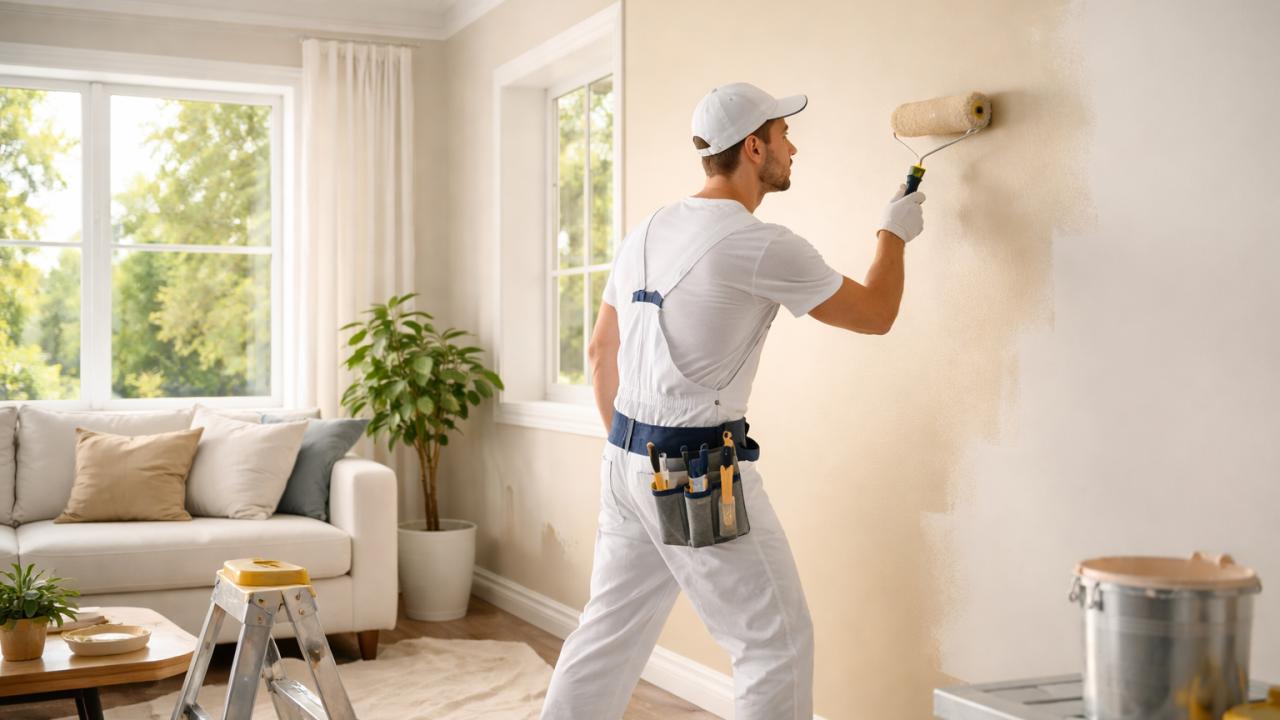
Choosing a colour gets all the attention, but the finish decides how a wall looks in daylight, how well it hides bumps, and how easily it wipes clean. Most paint ranges come in four or five finishes, and the names vary between brands. This guide explains what each finish means, how they are measured, and which one suits each part of a home.
What are the main types of paint finish?
The main paint finishes, from least to most shiny, are flat (also called matt), low sheen, semi-gloss and gloss. Some brands add in-between names such as eggshell, satin or velvet, but every finish sits somewhere on that same scale.
Flat paint reflects very little light, so it hides small dents and joins well but marks more easily. Low sheen has a soft glow and is the usual choice for living areas. Semi-gloss is harder wearing and easier to wipe, which is why it is common on doors and trim. Gloss is the shiniest and toughest, and also the least forgiving of surface flaws.
H2: What are the sheen levels of paint, in order?
Sheen is measured in gloss units, using a meter that shines light at the paint surface at a 60 degree angle. The higher the number, the shinier the finish.
In Australia, the Australian Paint Approval Scheme (APAS), run by CSIRO, sets performance specifications that paints can be certified against. Its specification AP-S0200 defines a semi-gloss finish as 25 to 50 gloss units at 60 degrees, and a gloss finish as 50 to 85 gloss units at 60 degrees. Flat and low sheen paints sit below semi-gloss on the same scale.
This is the most useful thing to know when comparing brands. Names like satin and eggshell are marketing terms, and the gloss level on the product data sheet tells you more than the name on the tin.
Low sheen or semi-gloss: which should you choose?
For most walls, choose low sheen. For doors, skirtings, architraves and window frames, choose semi-gloss.
Low sheen on walls gives a soft finish that does not highlight every bump in the plaster, and it is still easy to wipe. Semi-gloss on trim stands up to knocks, hands and cleaning, and the slight contrast in sheen between walls and trim gives a clean, finished edge.
A higher sheen is not always better. The shinier the paint, the more it shows patches, poor filling and uneven plaster, so higher sheens need better preparation underneath.
What finish do professional painters use?
Most professional repaints use a low sheen finish on walls and a semi-gloss finish on trim, and that is the system we use. On interior walls we use Haymes Expressions Low Sheen. On doors and trim we use Haymes Ultratrim Semi Gloss, which Haymes lists as APAS 0260/2 approved. On exteriors we use Haymes Solarshield Low Sheen, which Haymes lists as APAS 0280/5 approved for its white, ultra deep, dark and extra dark tint bases.
You can read more about how we approach walls, ceilings and trim on our page about our interior painting service, and about outside surfaces on our exterior house painting page.
Which paint finish suits each room?
- Ceilings: flat, because it hides joins and does not reflect light into your eyes.
- Living rooms, bedrooms and halls: low sheen, which balances a soft look with easy cleaning.
- Kitchens, bathrooms and laundries: low sheen or semi-gloss, depending on how much wiping the walls get. Use a paint made for wet areas where moisture is constant.
- Doors, skirtings, architraves and window frames: semi-gloss for a hard wearing, easy to clean surface.
- Exterior walls: an exterior low sheen system is the most common choice for weatherboard, brick and render.
Does the finish change how a colour looks?
Yes. The same colour can look slightly richer in a higher sheen, because more light reflects off the surface, and slightly softer in a flat or low sheen. That is one reason to look at a colour in the finish you plan to use, on the wall itself, before committing.
Light changes it too. A north-facing room and a south-facing room can make the same colour and finish read quite differently, so it is worth checking samples at different times of day.
Can you change from one finish to another?
Yes, but the surface needs preparing first. Glossier paint is smooth and hard, so new paint grips it poorly unless the old finish is cleaned and lightly sanded to dull it. Moving from gloss to low sheen without that step is a common cause of paint peeling later.
Frequently asked questions
Is satin the same as semi-gloss?
Not always. Satin is a brand name for a finish that usually sits between low sheen and semi-gloss, and different brands place it differently. Check the gloss level on the product data sheet rather than the name on the tin.
What does APAS approval mean on a paint tin?
APAS is the Australian Paint Approval Scheme, run by CSIRO. An APAS approval means the product has been certified against a published performance specification, such as the specifications for semi-gloss or exterior water based paints.
Can I paint low sheen over a semi-gloss wall?
Yes, once the semi-gloss is cleaned and lightly sanded to dull the surface. Without that preparation the new paint can struggle to grip and may peel later.
If you would like help choosing finishes for your home, colour consultation is included with every Hillcrest job. Call Steve on 0419 581 575 for a free written quote.